


 BitgetFeatured
20%Lifetime trading-fee rebate
- On eligible trading fees
- Qualifying tasks and exchange terms apply.
Optional cookies help measure visits. We count visits without cookies; clicks wait for your permission. Privacy Policy
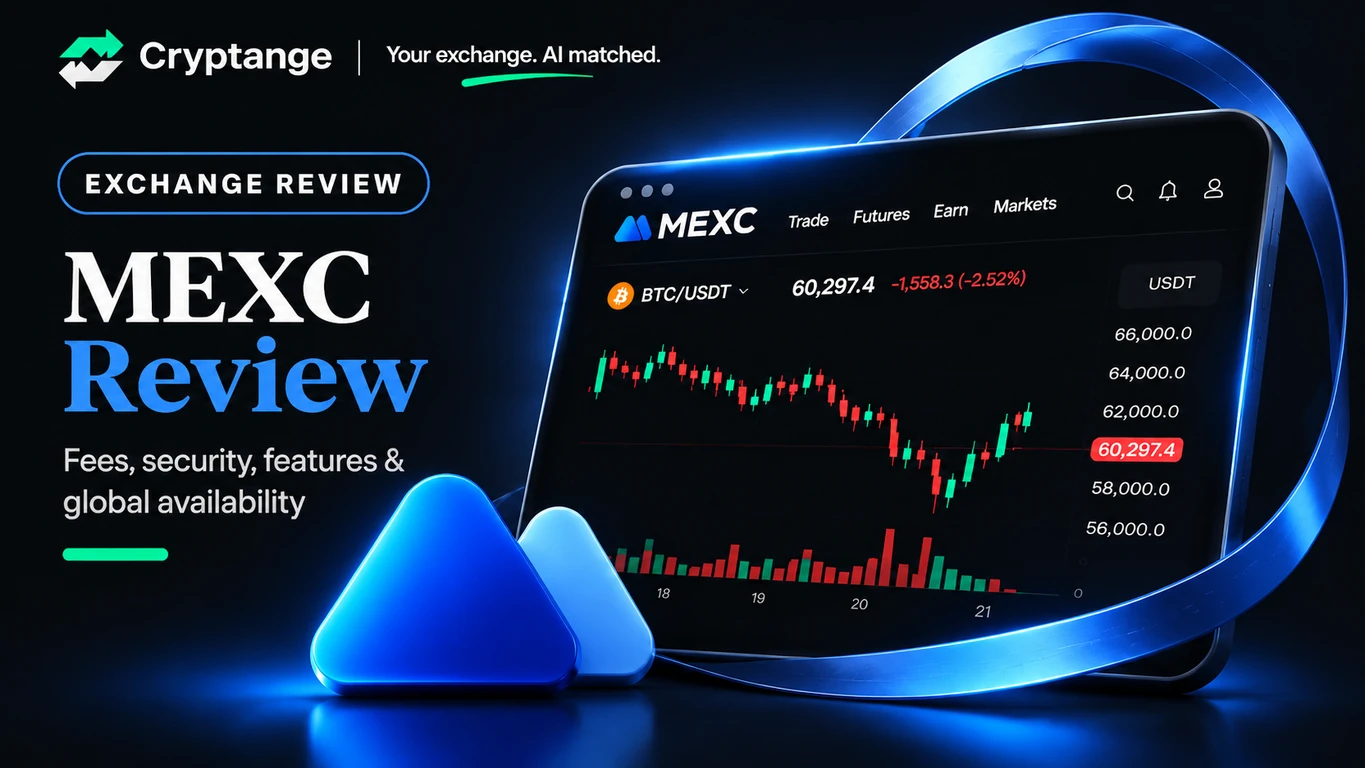
MEXC may enter an eligible trader’s shortlist when a particular market or account-specific fee arrangement matters. Read the verdict
Base-tier rates from the fee section below.
Research updated
A zero in one fee column does not describe the cost of the whole trade. The market, order type, region and access method can all change the calculation.
You find a token, open its market and see a zero maker fee. It is tempting to stop comparing there.
But will your order actually be a maker? What happens when you need to sell? Is that the rate for this pair, your account and the way you send the order? Can you withdraw the asset on the network you intend to use?
MEXC’s pricing deserves those questions. Its documentation describes differences between standard and special-rate pairs, web/app and API execution, and some regional arrangements. A review that compresses all of that into “zero-fee trading” is not useful enough.
There is also a recent regulatory development to read before funding: FinCEN announced a MEXC-related order on November 6, 2026. The Federal Register notice lists December 10, 2026 as the effective date. The scope and dates are explained below; this should not be mistaken for a blanket statement about every country. (FinCEN: November 6, 2026 MEXC announcement; Federal Register: November 10 notice, December 10 effective date)
MEXC may enter an eligible trader’s shortlist when a particular market or account-specific fee arrangement matters. It deserves closer scrutiny when the attraction is simply a token listing, high leverage or a welcome headline.
| Your reason for looking | The next question |
|---|---|
| A particular token | Is there usable depth and a supported withdrawal route? |
| A zero maker fee | Will my order rest on the book or execute immediately? |
| Futures pricing | Which contract, region and execution channel does the rate cover? |
| API trading | What separate schedule applies to automated orders? |
| A welcome campaign | Do the tasks fit activity I already intended? |
| Moving funds in or out | What current restrictions and operational notices affect the route? |
This is not a general endorsement of every listed asset or a country-availability determination. The decision must work at the account, product and transaction level.
Method: this review uses official documentation and regulatory notices. Cryptange has not independently tested market depth, withdrawal speed or the execution of an automated strategy.
On November 6, 2026, FinCEN announced an order aimed at cutting MEXC Global off from the U.S. financial system. The agency said the order prevents U.S. financial institutions from processing funds transfers involving MEXC Global. (FinCEN: November 6, 2026 MEXC announcement)
The Federal Register notice published November 10 identifies December 10, 2026 as the action’s effective date and describes prohibited transmittals involving covered financial institutions. At this article’s November 16 research date, that effective date is still ahead. (Federal Register: November 10 notice, December 10 effective date)
These are material facts for a platform review. They are not a basis for inventing a universal legal conclusion for all users or claiming that every withdrawal is currently blocked.
The practical question is whether the exact service and payment route you intend to use remain supported. Read current provider notices and the operative order where relevant. A low trading fee does not answer a payment-access question.
MEXC’s spot-fee article, with data dated November 13, 2026, describes a standard 0% maker rate and 0.05% taker rate. It also identifies zero-fee pairs and higher special-rate examples, and directs readers to the official fee page and their account’s applicable rates. (MEXC spot fee examples, data dated November 13, 2026)
| Documented example | Maker | Taker |
|---|---|---|
| Standard spot pair | 0% | 0.05% |
| Pair carrying a valid zero-fee designation | 0% | 0% |
| LUNA/USDT example in the dated article | 0% | 0.08% |
| AIDOGE/USDT example in the dated article | 0% | 0.20% |
These are dated illustrations of the pricing differences, not permanent promises about those pairs. Check the current pair designation and account fee before trading. (MEXC spot fee examples, data dated November 13, 2026)
| Assumed taker rate | Fee on $1,000 |
|---|---|
| 0% | $0.00 |
| 0.05% | $0.50 |
| 0.08% | $0.80 |
| 0.20% | $2.00 |
Illustrative execution costs only. Payment costs, spread, slippage and withdrawals are excluded.
The same transaction size can therefore produce different charges on different markets. Calling the exchange cheap without specifying the pair leaves out a decision-changing detail.
A maker order rests on the order book and provides liquidity. A taker order matches available liquidity. A limit price alone does not establish maker treatment if the order crosses the book immediately.
Consider someone who buys with a resting order but later needs to sell quickly. Their entry may qualify for the maker rate while their exit uses the taker rate. Both sides belong in the plan.
Execution quality matters too. A zero commission on a thin market does not guarantee a good average fill. Check the spread and the quantity available near your intended price. A market order can consume several price levels; the displayed last price is not a promise for the full order.
For a small-cap token, the ability to exit may matter more than saving a fraction of a percent on entry. A listing is evidence that a market exists, not evidence that the asset is suitable or that its liquidity will remain stable.

MEXC’s fee guide describes different futures rates across contracts, including major-pair and standard-tier examples. It also separates API pricing from website and app pricing. (MEXC fee overview and contract differences)
Regional notices add another layer. An October 2026 announcement set out 0.01% maker and 0.04% taker rates for specified WLD, ONDO, INJ and TIA contracts for select users in Pakistan and Bangladesh. It explicitly instructed users to check their account’s fee page. That notice is not a universal rate for every contract or every user in either country. (MEXC selected-contract fee adjustment for Pakistan and Bangladesh)
To show the effect, assume $10,000 entry and exit values and use those 0.01%/0.04% rates purely as an example:
| Execution pattern | Entry | Exit | Total |
|---|---|---|---|
| Maker → maker | $1.00 | $1.00 | $2.00 |
| Maker → taker | $1.00 | $4.00 | $5.00 |
| Taker → taker | $4.00 | $4.00 | $8.00 |
Illustrative contract-specific arithmetic, not a global MEXC quote. Funding, slippage and other costs are excluded.
This calculation follows the executed exposure. A smaller margin deposit does not make the position’s trading fee proportionately smaller.
Check the exact pair and contract.
Check the regional schedule and account.
Standard trading and API schedules can differ.
MEXC’s May 28, 2026 API announcement states that, from June 1, its futures API maker/taker rates change to 0.06%/0.08%. It says the separate API schedule takes precedence over web/app promotions. However, an example lower on the same page still uses the earlier 0.04%/0.06% rates. (MEXC futures API fee update and conflicting example)
That is an internal source conflict, not a reason to silently select the cheaper number. The dated update table points to 0.06%/0.08%, but an API user should confirm the effective account schedule before running a strategy.
| Hypothetical API calculation using the update table | Fee |
|---|---|
| $10,000 maker execution at 0.06% | $6.00 |
| $10,000 taker execution at 0.08% | $8.00 |
| Two $10,000 taker executions | $16.00 |
These figures illustrate the table’s rates; they do not resolve the source conflict for your account. A backtest using a promotional web rate can materially understate automated trading costs.
MEXC’s futures terminology guide describes funding as a payment between opposing perpetual positions and notes that settlement timing can vary by pair. It also explains liquidation and auto-deleveraging mechanisms. (MEXC futures information terminology)
For a hypothetical $10,000 position, a 0.01% funding rate produces a $1 payment if you are on the paying side. The next rate need not be the same. Holding across several events changes the cost calculation, while price movements can dwarf the funding amount.
Before opening a position, identify its margin arrangement, maintenance requirements and the relevant liquidation information. A stop order’s trigger and its execution are different events; neither a chart line nor a displayed estimate guarantees an exact exit.
MEXC documents demo trading as a way to practice the futures interface. (MEXC futures app guide and demo trading) A simulation can teach controls and order mechanics without establishing that live fills or emotional decisions will match the exercise.
MEXC’s February 5, 2026 announcement says users must complete KYC to access platform services and withdrawal features. It describes restrictions on funding and trading for unverified users. (MEXC KYC platform-access notice)
That makes older blanket “no KYC” descriptions unsuitable as current onboarding guidance. The user agreement also permits requests for identity and supporting documents, with restrictions possible when required information is not supplied. (MEXC user agreement)
Complete the verification relevant to your actual account and product. Do not assume that an advertised withdrawal limit guarantees immediate access to every feature or exemption from additional review.
The terms’ prohibited-jurisdiction list includes the United States, United Kingdom, Canada and several other locations. This is not the full list, and the exact current terms must be checked. A website loading successfully does not establish eligibility. (MEXC user agreement)
A token’s ticker is not enough to identify a transfer. Check the supported network, exact asset and receiving wallet requirements. If a memo or tag is required, it is part of the destination.
Before purchase, look for the minimum withdrawal, displayed charge and any maintenance or delisting notice affecting the route. Where the information is missing, treat the route as unresolved rather than assuming it will be available later.
| Before buying | Before withdrawing |
|---|---|
| Check the pair’s actual fee | Check the current withdrawal charge |
| Inspect spread and nearby depth | Match asset and network at both ends |
| Review the token’s identity | Include required memo or tag |
| Confirm a supported exit route | Check operational status and minimum |
A lower trading commission cannot compensate for choosing an unsupported network or buying an asset whose exit route you have not understood.
Use the same pair, order size and execution assumptions when comparing another exchange. For futures, add the contract type, holding period, region and execution channel. For spot, add funding and withdrawal costs.
| Potential attraction | What can change the conclusion |
|---|---|
| Low maker fees | Taker exits and unfilled orders |
| Particular token markets | Thin depth, spread and withdrawal constraints |
| Promotional pricing | Pair, region, timing and channel conditions |
| API access | Separate fee schedule and documented discrepancies |
| Welcome rewards | Required activity and reward restrictions |
Use Cryptange Compare for consistent assumptions and the AI Exchange Finder to explore alternatives. Read current service and regulatory notices alongside the trading comparison.
No. Rates can vary by pair, maker/taker role, region, promotion and execution channel. Funding and withdrawal costs are separate.
Not without checking the API schedule. MEXC explicitly describes separate futures API pricing.
The update table lists 0.06% maker and 0.08% taker, while the page’s example retains older figures. Confirm the effective account rate before relying on either in a live strategy.
The February 2026 platform-access notice requires verification for funding and trading features. Do not rely on older no-KYC summaries.
That is not what this review establishes. The cited action concerns covered financial institutions and specified funds transmittals. Country eligibility and the user’s actual service require separate checks.
No. Listing, liquidity, project quality, custody and transfer support are separate questions.
If the account, service and funding route fit your circumstances, Cryptange’s HEADSTART offer provides access to up to $10,000 in task-based new-user rewards, subject to the campaign presented by MEXC.
| Offer detail | Information |
|---|---|
| Code | HEADSTART |
| Maximum | Up to $10,000 in task-based rewards |
| Potential requirements | Eligible identity checks, deposits, holding or trading tasks |
| Before participating | Confirm reward type, claim window and withdrawal restrictions |
Explore MEXC’s HEADSTART campaign
The maximum is conditional, not an automatic cash credit. Do not let a reward replace the access, cost and withdrawal checks described above. Additional activity can create costs and losses larger than the reward.
Affiliate disclosure: Cryptange may earn a commission through this referral link. Commissions do not influence our exchange rankings. Read our affiliate disclosure.
Research prepared 16 November 2026. Educational information, not a personal investment recommendation. Fees, service access, regulatory developments and campaign terms can change.
Bybit’s spot and futures fees, funding, margin controls, security history and regional differences.

Calculate maker, taker and funding costs on the right exposure, then account for execution and conditional rebates.

Separate account security, custody and solvency. Build a useful evidence record without inventing a safety score.


