


 BitgetFeatured
20%Lifetime trading-fee rebate
- On eligible trading fees
- Qualifying tasks and exchange terms apply.
Optional cookies help measure visits. We count visits without cookies; clicks wait for your permission. Privacy Policy

Separate account security, custody and solvency. Build a useful evidence record without inventing a safety score.
AI-assisted editorial preparation; verification pending.
Quick answer: Trustworthiness is not a single property. An exchange can have strong login controls yet expose customers to custody or solvency risks. A visible company registration does not establish permission to offer every product in every country. Examine distinct risks using evidence with a clear scope and date; when that evidence is missing, keep the question unresolved rather than filling in a score.
The URL uses the familiar phrase “trust score,” but this guide does not present a Cryptange-certified rating. There are no externally certified scores, star ratings or assurances of safety here. The framework helps you ask better questions and record defensible answers. It is a method for examining uncertainty, not a promise that diligence eliminates it.
When you use a custodial platform, several things must work at once: your account must remain under your control, the platform must operate correctly, assets must be held and accounted for as described, and withdrawals must be possible under applicable rules. A failure in one layer can matter even when the others look sound.
Write down what you depend on. Who controls private keys? Which company is your counterparty? What happens if you lose access to your phone? Which asset or banking rail funds withdrawals? Are positions collateralized through the same account? This makes “I trust the exchange” a series of examinable statements rather than a feeling about a familiar logo.
Different users face different dependencies. Someone buying a small amount occasionally has different operational exposure from a trader leaving collateral on a platform continuously. That difference changes the questions to prioritize; it does not prove one user is protected or one venue is universally best.
Authentication and withdrawal controls address particular attack paths. Ask whether the documented controls actually apply to the account and whether recovery bypasses them. Strong authentication can still be undermined by compromised recovery channels, phishing, stolen sessions or an attacker persuading the user to authorize a transfer.
Solvency concerns assets, liabilities and the ability to meet obligations. A secure login screen cannot demonstrate that assets exceed liabilities, that reserves are unencumbered, or that a company can survive a run on withdrawals. Treat account security and financial condition as separate evidence categories.
The same separation applies to insurance language. Ask who is insured, what event is covered, who can claim, which assets are excluded and what limits apply. An insurance claim in marketing is not automatically a promise that every customer balance will be reimbursed. If the underlying policy and customer rights are unclear, record that limitation without inventing coverage.
“Cold storage,” “segregated” and “third-party custody” each describe something different. Cold storage refers to a key-management arrangement, not a complete legal treatment of assets. Segregation can mean separate records, separate accounts or a stronger legal arrangement; the agreement must establish what the word means in context.
If a third-party custodian is named, investigate who contracts with it and what rights customers have. Assets held with another organization may still be subject to the exchange’s terms and liabilities. The presence of a recognizable custodian name does not by itself establish a direct claim by the customer or priority in an insolvency.
For a hypothetical comparison, Platform A documents key controls but gives little detail on customer asset treatment. Platform B explains legal custody treatment but provides sparse operational detail. The honest conclusion is not that either is “safer.” Each answers one question and leaves another open. List those gaps and determine whether they are material to your intended use.
A reserve report may show assets or address balances at a specified moment, with a specified method. The important words are “at a specified moment” and “with a specified method.” It does not automatically establish the complete liability picture, ownership rights, encumbrances or future availability of those assets.
The PCAOB Investor Advocate advisory on proof-of-reserves reports cautions that these reports are not audits and may omit important issues. This is US investor-education context, not an assessment of any exchange in this guide. Do not translate a third-party report logo into a blanket approval.
Ask what assets and entities were included; whether customer liabilities, borrowings and related-party obligations were assessed; whether the work addressed rights and obligations; and when the evidence was captured. A technical ability to verify inclusion of a balance may be useful within its scope while leaving broader financial questions unanswered.
Consider an illustrative report showing $120 million in selected wallets. Without complete liabilities, ownership and encumbrance information, it cannot establish that $100 million of customer obligations are fully covered. Those numbers are hypothetical; they illustrate missing denominators, not a finding about a real provider. Nor should evidence from one group entity be silently assigned to another.
Reputation can alert you to questions, but online sentiment is not a controlled study. Viral complaints may reveal a real problem or reflect incomplete facts. Positive testimonials can be selective or promotional. Neither should be converted directly into a numerical safety score.
For an incident, identify the primary account: the provider’s incident report, a regulator’s notice, a court record or another document appropriate to the event. Distinguish allegations, confirmed findings and the provider’s response. Record date, affected product and entity, claimed remediation and unresolved questions. Avoid turning “the company says it resolved this” into “independently verified resolution.”
A long operating history does not prove future reliability. An incident also does not answer every current question by itself. Examine what changed and what evidence supports the change. A meaningful history review follows the underlying event rather than selecting whichever anecdote supports a preferred brand.
A genuine operating company, product permission and user eligibility are related but distinct. Identifying a legal entity can help distinguish an actual business from impersonation. It does not prove that every service offered under the brand is authorized for your location or customer category.
When researching authorization, use the relevant regulator’s register or notice for the precise entity, activity and jurisdiction. Do not assume a registration means a broad licence, that one licence covers all products, or that permission in one market extends worldwide. This guide establishes no current country-specific regulatory status for any exchange.
Access rules are another layer: a platform’s own terms may restrict a user even where a local framework exists. Conversely, Cryptange’s absence of a reviewed licensing finding is not automatically an admission ban. Our methodology and finder preserve these distinctions. Legal advice about your circumstances belongs with a qualified adviser, not an inferred trust badge.
Before transferring assets, identify accepted networks, minimums, processing conditions, withdrawal controls and recovery procedures. A token name alone is insufficient where multiple networks exist. A mistaken network or address can create losses that an exchange comparison cannot undo.
Read whether withdrawals can be paused for security reviews, maintenance, compliance checks or other reasons. “Withdrawals supported” does not mean every request completes immediately. At the same time, a delay should not be casually described as insolvency without evidence. Keep operational status, individual account review and financial condition separate.
A small transfer, if you independently decide it is appropriate, may reveal something about your workflow at that moment. It is not a solvency test or proof that a large future withdrawal will work. Cryptange has not conducted such tests for this article and does not invent execution screenshots or customer experiences.
Trustworthy disclosure is not the same as low pricing. A clearly stated high cost can be easier to assess than an attractive rate whose conditions are hidden. Look for the schedule that applies to your exact service, account tier and region, plus conversion, deposit, withdrawal and product-specific items.
Kraken’s fee schedule illustrates service distinctions; Bybit’s trading fee documentation illustrates account-rate dependencies. They support the need to identify the correct schedule, not a comparative endorsement of those venues.
For derivatives, maintain the distinction between trading fees and funding transfers. A “zero fee” label can leave spread, execution shortfall or carrying costs unaddressed. Our futures-cost guide shows the accounting. Transparency should make obligations legible, including what is not covered by an advertised price.
Operational reliability includes order handling, access to account records, incident communication and recovery from interruptions. A polished interface or a successful demonstration session does not establish performance under market stress. A publicly reported uptime number also needs scope, measurement method and exclusions before it is comparable.
Ask where status notices appear and what the terms say about outages. Can you export fills and balances? Can you distinguish a cancelled order from an unfilled active order? What happens to conditional orders during maintenance? Answers must come from documentation or appropriately scoped observation, not presumed platform features.
Plan around uncertainty. Connectivity can fail outside the platform; devices and authentication methods can fail too. That does not justify evading security controls. It argues for understanding recovery procedures before an urgent situation. No operational plan turns leveraged exposure into a safe asset.
Evidence is not simply “official good, unofficial bad.” A customer agreement is primary for contractual terms; a provider’s marketing claim is much weaker for proving outcomes. A regulator’s register is relevant to a scoped authorization question, not necessarily to execution quality. A financial audit has a defined entity, period and opinion; it is not an all-purpose guarantee.
| Question | More useful evidence | Scope still to inspect |
|---|---|---|
| Who contracts with me? | Applicable customer agreement | Region, entity and version |
| What account controls exist? | Product documentation | Availability and recovery exceptions |
| What does a reserve report establish? | Full report and methodology | Assets, liabilities, rights and date |
| Is an activity authorized locally? | Relevant regulator’s register or notice | Exact entity and permitted activity |
| What happened in an incident? | Primary records and dated response | Confirmed facts versus claims |
| What would my trade cost? | Applicable schedule and defined workflow | Tier, service and execution assumptions |
Use secondary reporting to discover primary material and competing explanations. If a claim depends on a document you cannot access, say that. Do not imply you manually reviewed a full report because you saw a headline about it.
A missing fact has no justified numeric value. Giving it zero confuses “we do not know” with “we measured failure”; giving it full marks rewards opacity. Both distort comparisons. The right status may be unresolved, not assessed, contradicted or stale.
Dates matter by claim. A past incident remains part of history even when a current fee quote expires. A reserves snapshot cannot be rolled forward by changing the page’s review date. Record when the source describes its subject and when the research was prepared; those are different timestamps.
Cryptange’s approved research remains the source for current specific exchange facts in the product. Educational references here do not create new rankings or override freshness gates. Commission and offers have zero influence on ranking. A published explanation of trustworthiness is not an announcement that we now have independently certified trust scores.
Make one row per claim rather than one score per brand. For each row, write the entity, product, question, source link, source date if provided, research date, conclusion and limitation. Use “not provided” when a source does not supply a date; do not manufacture one.
A hypothetical record might read: “Account recovery process described in help page; implementation not independently tested.” Another might say: “Reserves report available for named entity and date; full liability coverage unresolved.” These are useful conclusions precisely because they resist expanding beyond their evidence.
Ask which unresolved issues would stop you from using the account. If custody treatment is mandatory for your decision, a good interface cannot compensate for that gap. If no candidate answers your essential questions, “wait” is a valid outcome. Research should improve a decision, not pressure you to pick from an incomplete list.
No. The work, scope and assurances differ. Read the complete report and limitations rather than treating the words as interchangeable.
No. Usage can describe behaviour within a measured population. It does not establish solvency, customer rights or local product authorization.
It should not. Cryptange’s commissions and offers do not alter ranking. A commercial relationship must be disclosed separately, not used as evidence of quality.
No. It is an educational framework with unresolved questions made explicit. It provides neither certification nor assurances of safety.
Imagine two entirely hypothetical platforms and a reader who plans to buy an asset monthly, keep only a small working balance on an exchange and withdraw to a wallet they control. Neither platform is a recommendation. The example deliberately leaves some questions open.
Platform A has detailed authentication documentation and a reserve report, but its customer agreement does not clearly explain the reader’s rights to assets in insolvency. Platform B explains the contracting entity and custody arrangement more clearly, but its recovery documentation leaves uncertainty about how a lost authentication device is handled. An attractive login screen does not settle A’s legal uncertainty. B’s clearer agreement does not prove its recovery process works under stress.
The reader should first identify which uncertainty is essential to the intended workflow. If recovering account access is a mandatory requirement, B needs further investigation before it belongs on a practical shortlist. If documented asset treatment is mandatory, A’s gap cannot be offset by a lower fee. There is no need to assign either brand a made-up numerical penalty. An unresolved essential question can simply prevent a decision.
| Hypothetical observation | Defensible conclusion | Conclusion to avoid |
|---|---|---|
| A describes withdrawal address controls | A documented control exists within the stated scope | Every withdrawal is protected |
| A provides a dated reserve report | Selected balances were reported at that date | The whole group is solvent today |
| B names the contracting entity | The agreement identifies a counterparty | Every service is locally authorized |
| B explains asset treatment | The contract provides information to investigate | Losses are impossible or insured |
| Neither provides a complete answer to a mandatory question | Further evidence is needed | Choose whichever logo looks familiar |
A useful shortlist is therefore conditional: “This candidate answers these questions; these other questions remain open.” The AI Exchange Finder can help surface researched product options, while comparison puts available facts alongside each other. Neither replaces reading the agreement that will apply to the account you actually open.
An incident statement usually contains several kinds of information: what the provider says happened, what was affected, what it says it changed, and what remains under investigation. Keep those layers separate. A statement of reimbursement is not necessarily evidence that every affected user received funds; a new control described in a statement is not an independent test of that control.
For a hypothetical service interruption, a report might state that withdrawals were suspended for three hours while a system was reviewed. That supports a bounded historical description if the report is the source. It does not establish insolvency, prove there was no asset loss, or demonstrate that a similar interruption cannot recur. If a regulator or court later publishes findings, record those findings separately and retain the difference between allegations and established facts.
Ask whether the incident affected the same entity, product and account arrangement you are considering. Group-level history is relevant context, but silently transferring an event or reassurance across entities can mislead. Preserve the chronology rather than replacing the old event date with a new article update date.
Never send passwords, seed phrases or authentication codes to a referral publisher or purported support contact. If a message asks you to bypass a restriction or transfer assets to a personal wallet to unlock an account, interrupt the process. This checklist is educational risk awareness, not an audit of any current platform.
No. It can reveal something about one workflow at one moment, if you choose to perform it. It does not establish complete liabilities, unencumbered reserves or future withdrawal capacity. Cryptange has not conducted first-hand withdrawal tests for this guide.
No. Missing evidence and measured failure are different states. A critical unknown may prevent your decision, but inventing a number for it makes the comparison look more certain than the evidence allows.
By Cryptange Research Desk · Educational guide · Editorial review pending. Research prepared 4 November 2026. The source manuscript records source retrieval on 4 November 2026; this update does not claim a new source check or independent verification. Prepared for public preview with owner authorization. No human review or production publication date is asserted. Owner review is required before production deployment.
PCAOB proof-of-reserves advisory supports the reserve-report limitations. Kraken fee schedule and Bybit trading-fee structure support contextual pricing distinctions. Security, custody and evidence-record recommendations are editorial analysis, not claims that the named venues passed tests. Cryptange methodology, affiliate disclosure and finder explain the product boundaries. Art is a generated illustration, not audit evidence. Educational information, not financial or legal advice.
On eligible trading fees. Welcome rewards require qualifying tasks.
Welcome package up to 6,200 USDT
The 20% lifetime trading-fee rebate applies to eligible trading fees, not investment returns. It is distinct from an instant fee discount and from Bitget Card cashback. The welcome package up to 6,200 USDT requires qualifying tasks; reward type, eligibility and timing must be confirmed on Bitget.
CASHBACKCryptange may earn commission. It does not affect rankings or matching. Affiliate disclosure
Kraken app versus Kraken Pro, margin and futures costs, security settings and regional access.
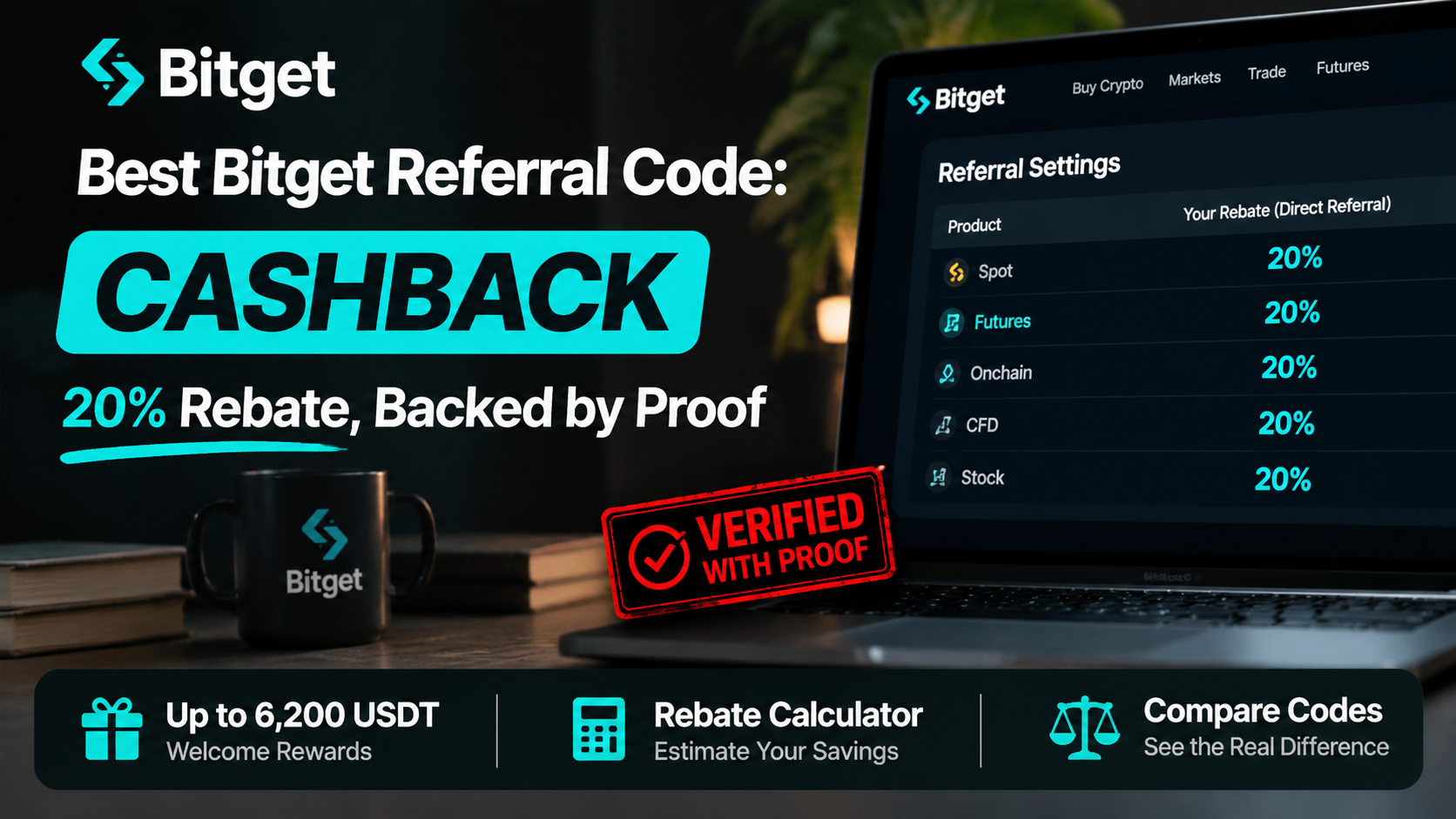
The recorded CASHBACK 20% direct-referral setting, Bitget Support’s payout explanation, fee maths, affiliate tiers and separate welcome-reward conditions.

Access, custody, true costs and a practical shortlist worksheet—starting with your needs, not a ranking.


