


 BitgetFeatured
20%Lifetime trading-fee rebate
- On eligible trading fees
- Qualifying tasks and exchange terms apply.
Optional cookies help measure visits. We count visits without cookies; clicks wait for your permission. Privacy Policy

Understand reward types, eligibility and incremental costs before letting a welcome offer influence your decision.
AI-assisted editorial preparation; verification pending.
Quick answer: A referral code identifies a relationship; a bonus describes a conditional benefit. Neither guarantees that you qualify, receive cash, or save money overall. Read the official terms for your location, account and product, identify the reward type, and calculate costs for activity you would otherwise choose to do. A headline maximum should never decide whether you take trading risk.
The editorial examples are not live offers or promises of eligibility. Separate, clearly disclosed partner modules present the existing owner-supplied listings. Numerical examples are invented solely to explain arithmetic and are labelled hypothetical. They are not offers from the named educational sources or from Cryptange.
A signup promotion may reward account creation, verification, deposits, trading or a combination. A referral relationship may instead pay the referring publisher, the new user, both or neither until conditions are met. Using a code does not establish which benefits attach to that account.
Distinguish a campaign from a permanent fee schedule. A temporary discount may sit alongside volume tiers, while a cashback arrangement may reimburse a portion of eligible fees after they have been paid. The timing and basis of the calculation matter. A “bonus” can also be noncash credit whose permitted use is tightly restricted.
Begin by translating the marketing headline into one precise sentence: “If I satisfy these conditions by this time, I may receive this type of benefit under these restrictions.” If you cannot complete that sentence from the official terms, the value is not established. Do not fill the blanks with what a referral publisher implies.
A cash-like reward may still require a claim, vesting period or withdrawal conditions. A trading credit can be usable only as margin or to offset certain charges; it may expire or be forfeited when transferred. A voucher can be a right to a future discount rather than an asset you own today.
Fee cashback usually refers to a fraction of qualifying fees, not a fraction of deposits or trading volume. A tiered rebate can depend on volume, account level, product or a special enrolment path. The reward base and exclusions should be explicit. Funding transfers, withdrawal charges and conversion costs may not be eligible.
| Reward label | Question to answer | Mistake to avoid |
|---|---|---|
| Signup promotion | Which tasks create entitlement? | Treating registration as automatic payment |
| Trading credit | What can it offset, and can it be withdrawn? | Counting credit as cash |
| Voucher | Which future charge is eligible, and when does it expire? | Assuming unlimited use |
| Fee cashback | Which paid fees form the rebate base? | Applying the percentage to notional or deposits |
| Tiered benefit | Which tier can this account actually reach? | Advertising the highest tier as typical |
The table is a taxonomy, not a claim that every exchange offers each type. Where terms conflict with a label, the terms control the practical meaning. Read them before transferring funds.
A headline can add several conditional tasks together: verify, deposit, trade one product, trade another, then complete a high-volume tier. Few readers may plan to do all of them. The maximum tells you the outer bound under that campaign’s rules, not what an ordinary account will receive.
Break the headline into tasks. For each one, note the condition, incremental action, benefit type and deadline. Do not count mutually exclusive tasks twice. If one task requires a product you would not otherwise use, its reward is not a reason to treat that product as suitable.
A hypothetical package advertising “up to 100 reward units” might contain 10 units for one task, 20 for another and 70 for a high-turnover requirement. A reader planning only the first task should not write 100 units in their cost comparison. Reward units in this illustration have no assumed dollar value or withdrawability.
Platform access and campaign eligibility are separate. A general account may be available while derivatives are restricted. A permitted product may still be excluded from a particular promotion. A new-user benefit may reject prior accounts, existing referrals, related accounts or customers who do not enrol through the required path.
Read residence, customer-category, age and identity-verification conditions. Identity checks are campaign- and venue-specific: do not assume either that every service requires the same checks or that a referral code bypasses them. If an exact requirement is unclear, record the uncertainty and ask the provider.
Country research in /countries and compatibility checks in /match do not promise promotion eligibility. Local licensing is a distinct researched question, not a shortcut from “popular here” to “all rewards allowed.” Never use false information, duplicate identities or location evasion to obtain a benefit.
Campaigns often have more than one clock. A signup window can differ from a deposit deadline, a trading window, a claim period and a voucher’s usable life. Record each separately, with the stated time zone. Do not infer that completing a task just before one deadline preserves every later benefit.
A task may be measured from registration, first deposit, activation or a calendar event. Settlement can happen later still. Determine whether a rebate is credited automatically, requires a manual claim or appears only after an assessment period. Also check whether withdrawals or transfers affect qualification.
Save the official terms you relied on and their date. That record helps explain what you understood; it does not guarantee enforceability or prevent a permitted program change. Expired campaigns are historical context, not available rewards. Cryptange should not revive an old offer by giving it a new research date.
A deposit supplies funds; trading volume records executions. A $1,000 deposit does not automatically meet a $10,000 turnover condition. Opening and closing a $5,000 position can create $10,000 of executed notional if the rules count both sides, but that counting method must be stated in the terms.
Do not use leverage merely to make a volume target easier to reach. It increases exposure relative to collateral and can introduce liquidation risk. A promotion’s accounting threshold is not a sensible position-size recommendation. Wash trading, self-matching or prohibited activity can also invalidate rewards under program terms; do not manufacture turnover.
Costs attach to the actual workflow. Trading fees, spread, slippage, funding, conversion and withdrawal charges can differ. Our futures-fee guide separates those lines. A reward may apply to only one of them, leaving the rest unchanged.
Assume, purely hypothetically, that a reader already intends two trades with $5,000 notional each. Assume an eligible execution fee of 0.05% for both trades and a campaign rebating 20% of those fees as withdrawable cash, with no binding cap. These are invented terms, not a live exchange promotion.
Each trade’s execution fee would be $2.50; both would total $5. A 20% rebate would be $1, leaving $4 of execution fees. The rebate is not 20% of $10,000 turnover and is not 20% of the deposit. It also does not automatically reduce funding, spread or withdrawal costs.
| Item | Hypothetical calculation | Amount |
|---|---|---|
| Total executed notional | $5,000 + $5,000 | $10,000 |
| Execution fees | $10,000 × 0.05% | $5.00 |
| Eligible cash rebate | $5 × 20% | $1.00 |
| Execution fees after rebate | $5 − $1 | $4.00 |
If the benefit is a future voucher instead of cash, the immediate cash cost remains $5. The voucher’s eventual realized value depends on eligible later use and expiry. Record contingent value separately; a balance shown in a rewards screen need not be spendable or withdrawable.
Consider a different hypothetical campaign offering a $15 cash reward after $50,000 of additional eligible turnover. Assume a 0.05% execution rate throughout. Fees on that additional turnover alone would be $25, already $10 more than the reward before spread, slippage, funding or market losses.
The deposit used to fund the activity is not itself necessarily a fee, and the volume figure is not a promise that collateral stays unchanged. The calculation does not estimate total loss; it shows that an apparently free benefit can require a negative incremental cash tradeoff even under simplified assumptions.
Now suppose the reader had already intended the full eligible turnover without the promotion. The incremental action differs, so the comparison can differ too. Evaluate the reward against the plan you would choose without it, not against a plan invented to justify claiming it. Do not treat a positive fee comparison as a prediction of trading profit.
A referrer may be compensated when users sign up, trade or meet other program conditions. That creates a commercial incentive to direct attention toward a service or increase activity. Disclosure makes the relationship visible; it does not remove the incentive or prove the offer is bad.
Ask whether the user benefit differs from a non-referral signup, whether the referrer benefits from continuing turnover, and whether enrolment is reversible. Do not assume every referral gives a discount; the relationship may primarily compensate the publisher. Nor should a publisher promise a benefit that the official terms do not support.
Cryptange may receive commission from disclosed affiliate links. Commissions and offers do not change exchange ranking or the finder’s compatibility decisions. See our affiliate disclosure. Partner promotions are disclosed separately from editorial explanations and do not establish suitability or campaign eligibility.
Once you have spent time on registration or paid fees on an initial trade, it can feel wasteful to stop before completing a reward ladder. Those costs are already incurred. The next decision is whether the remaining actions are worthwhile from now onward, not whether finishing would justify the past.
For a hypothetical reader who has completed two tasks, a third may require an unfamiliar derivative. Rejecting that task does not erase the value of making a prudent decision. The account and the promotion are separate choices; you can decide a reward is not worth pursuing even after signing up.
Avoid increasing exposure because the deadline is approaching. Urgency can impair careful reading of terms and risk. A missed reward is not a trading loss that must be recovered, and there is no obligation to “win back” the benefit through additional activity.
Be cautious about guarantees of profit, pressure to deposit immediately, requests for seed phrases or authentication codes, unofficial support accounts, altered domains and promises to bypass identity or location restrictions. A real brand name in a message is not proof that the sender represents that company.
Use the official site to find the relevant campaign terms; do not rely on a forwarded image, copied counter or private-chat assurance. A claim that a bonus has no conditions is suspect if the terms are absent. A request to send funds to an individual wallet to “activate” a reward deserves particular scrutiny.
Refuse instructions to create false accounts, misrepresent residency or trade with yourself. This guide does not identify any specific current scam or certify a campaign. These are practical warning patterns, not a substitute for investigating the exact communication.
Use Offers to read owner-supplied listings and their limitations, not to infer that these hypothetical illustrations are live campaigns. If current terms or eligibility cannot be established, the offer remains unresolved rather than attractive by default.
No. It may identify the referrer without changing the user’s schedule, or attach a conditional benefit. Read the actual program terms and applicable rate.
No. Permitted use, expiry, conversion and withdrawal rules determine its practical value. Do not count it as cash before those questions are answered.
A reward does not justify unwanted market exposure. Compare incremental costs and risk against the actions you would otherwise choose; the headline maximum is not a promise.
No. Measured usage, product access and campaign qualification are different concepts, each requiring its own evidence.
Start with the activity you would choose without a promotion. Imagine a hypothetical reader who intends to buy $500 of an asset once and then withdraw it. A campaign has three tasks: account verification, an eligible deposit and a derivatives-turnover target. The reader can examine the first two independently; the third does not become appropriate because it makes the headline larger.
Write down the incremental action for each task. If verification would already be required for the account, it may create no additional trading exposure, though privacy and access questions still matter. If funds must remain on the exchange for a specified period, the reader has additional custody exposure. If an unfamiliar derivative must be traded, the decision changes substantially. Those dependencies cannot be reduced to a single bonus amount.
| Hypothetical task | Incremental dependency | What needs confirmation |
|---|---|---|
| Verify an account | Identity information and account access | Exact provider requirements and permitted use |
| Make an eligible deposit | Funding route and custody exposure | Asset, network, minimum and measurement time |
| Hold a balance | Time with funds on the platform | Qualifying balance and withdrawal conditions |
| Reach turnover | Executions, costs and market risk | Products, eligible volume and excluded activity |
| Claim a voucher | Future eligible use | Expiry, cap and whether it is withdrawable |
A good decision can be to ignore the campaign, complete only an appropriate task, or stop entirely. The terms decide what benefits remain available in each case; the table is not a promise that partial completion earns a reward. Never manufacture turnover or misrepresent your location to satisfy a threshold.
A hypothetical $10 voucher is not equivalent to $10 received in a withdrawable settlement balance. If it offsets a future charge you would otherwise pay, it may eventually have useful realized value. If it expires unused, its realized saving is zero. Until the outcome is known, keep the voucher in a contingent-benefit column rather than deducting it from money already spent.
For example, imagine a reader pays $5 in execution fees and receives a voucher that can offset up to $3 of eligible fees next month. Immediate cash costs remain $5. If the reader later incurs $2 of eligible fees they had independently planned and uses the voucher, the realized saving is $2, not $3 and not the headline $10. Remaining nominal credit must still satisfy its own conditions. All figures and terms here are hypothetical.
The same discipline applies when a reward is paid in an asset rather than the reporting currency. Record the asset amount, the conversion basis if you calculate a reporting value, and whether withdrawal or conversion introduces another cost. Do not silently treat a token amount as a dollar balance or add USDT, dollars and euros into one invented total.
A referral route may attach an eligible fee rebate, a campaign task or simply a record of who referred the account. It may not be interchangeable with a later-entered code. Before using a link, confirm the exact signup path, account eligibility and whether an existing referral relationship can be changed. Do not open duplicate accounts to recreate new-user status.
Compare the terms shown for your account rather than assuming every publisher has the same arrangement. A referral code on a page does not prove that the benefit will be available in every country or for every product. The official terms and the eligibility checks at the exchange remain decisive.
Cryptange’s Offers page presents owner-supplied commercial listings, not independently reviewed campaign eligibility findings. The featured module below is advertising separate from this guide’s hypothetical calculations. It does not certify the exchange, promise a cash payout or change the AI Finder ranking.
Before proceeding, write one sentence for each of these questions: what would I do without the promotion; what extra actions does it require; what additional cash costs might those actions create; what reward type could I receive; and what conditions remain unresolved? This simple record makes an attractive headline less likely to obscure a material dependency.
If the answer depends on a support message, ask for the official terms that support it. Preserve the terms and their date for your own record, but do not assume a screenshot overrides the program agreement. A referral publisher should not ask for your password, seed phrase or authentication code to investigate a benefit.
Not necessarily. It is a description that must be read alongside the program’s applicable terms, exclusions and change provisions. Confirm what it means for the specific eligible fee arrangement; do not interpret the label as a guarantee of future pricing or permanent access.
Only if the actual terms explicitly include them. A trading-fee rebate ordinarily needs a defined eligible-fee base; applying its percentage to unrelated charges would invent a benefit. Keep each cost category separate until coverage is confirmed.
By Cryptange Research Desk · Educational guide · Editorial review pending. Research prepared 4 November 2026. The source manuscript records source retrieval on 4 November 2026; this update does not claim a new source check or independent verification. Prepared for public preview with owner authorization. No human review or production publication date is asserted. Owner review is required before production deployment.
Bybit referral FAQ provides contextual examples of task and time-window conditions; no live reward amount is reproduced here. Bybit VIP benefits and trading fee structure support tier and applicable-rate caveats. The worked campaigns are entirely hypothetical editorial examples, not extracted offers. Affiliate disclosure, referral and bonus guide and exchange selection provide related reading. Educational references never establish country eligibility or enter exchange ranking. Generated art is decorative, not evidence of a reward. Educational information, not financial or legal advice.
On eligible trading fees. Welcome rewards require qualifying tasks.
Welcome package up to 6,200 USDT
The 20% lifetime trading-fee rebate applies to eligible trading fees, not investment returns. It is distinct from an instant fee discount and from Bitget Card cashback. The welcome package up to 6,200 USDT requires qualifying tasks; reward type, eligibility and timing must be confirmed on Bitget.
CASHBACKCryptange may earn commission. It does not affect rankings or matching. Affiliate disclosure
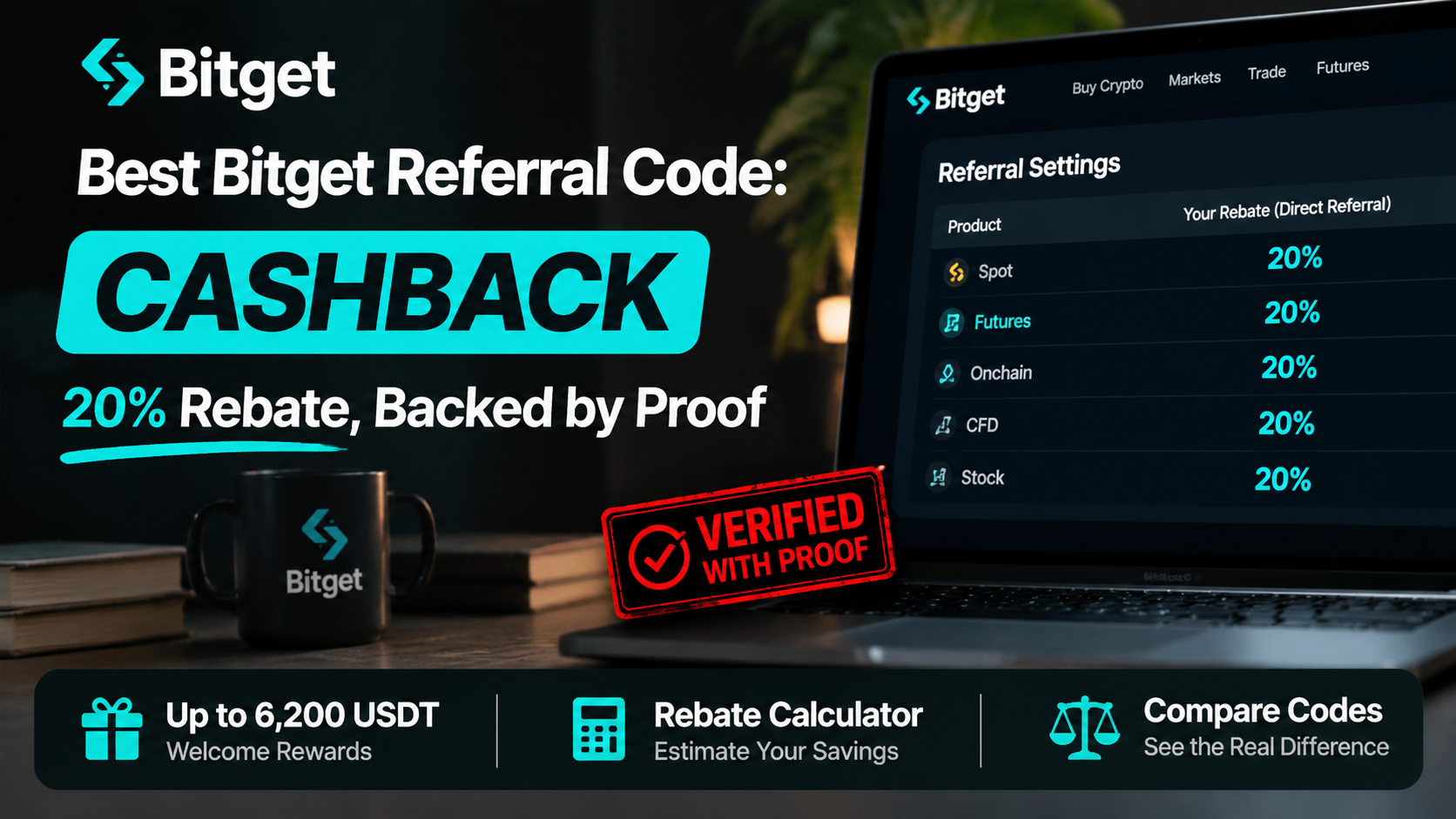
The recorded CASHBACK 20% direct-referral setting, Bitget Support’s payout explanation, fee maths, affiliate tiers and separate welcome-reward conditions.
Kraken app versus Kraken Pro, margin and futures costs, security settings and regional access.

Access, custody, true costs and a practical shortlist worksheet—starting with your needs, not a ranking.


