


 BitgetFeatured
20%Lifetime trading-fee rebate
- On eligible trading fees
- Qualifying tasks and exchange terms apply.
Optional cookies help measure visits. We count visits without cookies; clicks wait for your permission. Privacy Policy
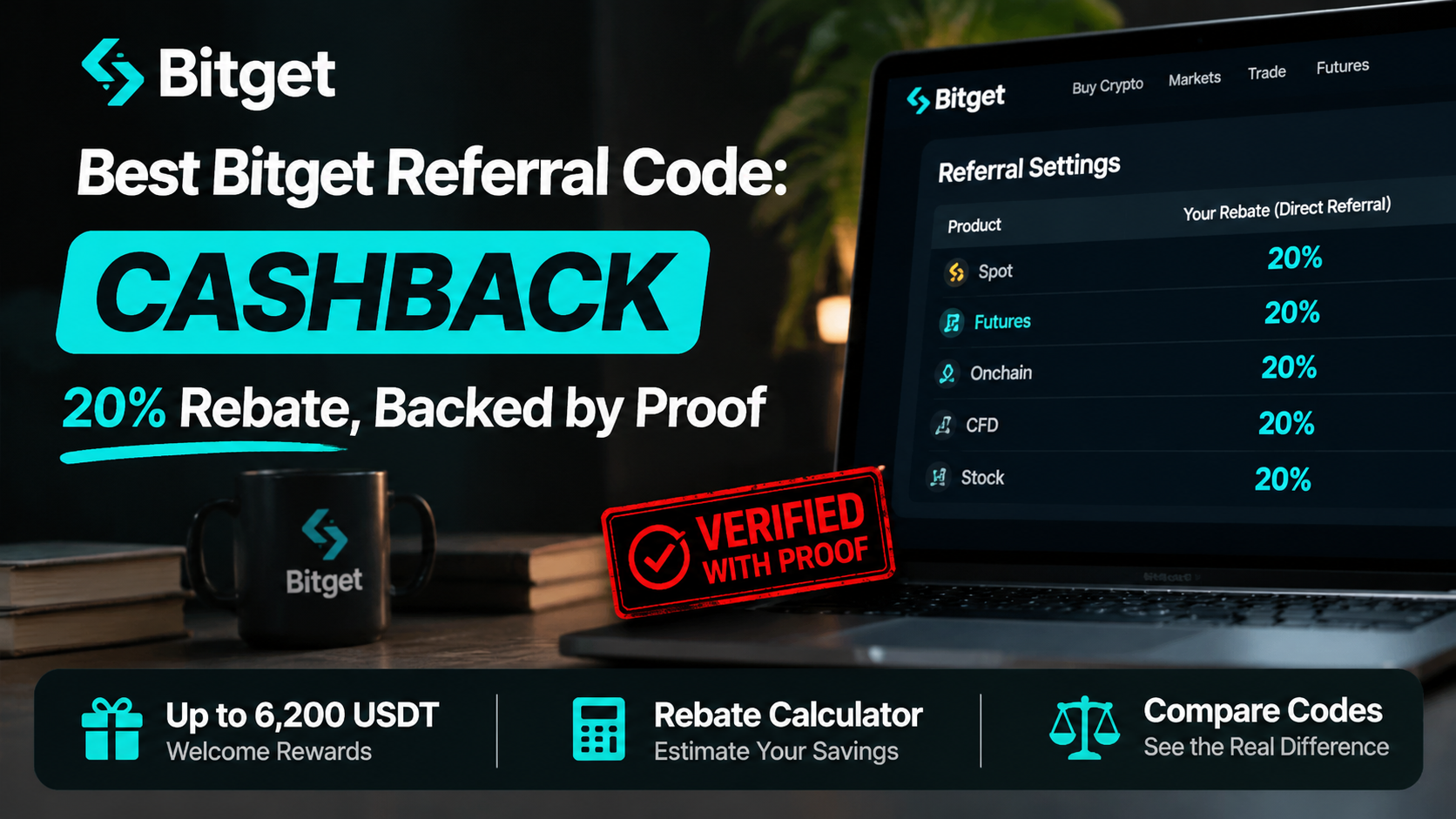
A practical guide to the verified trader-side rebate setting, how the fee maths works, what the 40–50% affiliate figures really mean, and how Bitget's separate welcome rewards are structured.
A 50% headline looks better than 20%—until you ask who receives the 50%.
Bitget referral pages often mix up two different things: the commission an affiliate earns and the rebate a new trader receives. They are not interchangeable. If you're choosing a code because you want lower trading costs, the number that matters is the share returned to your account.
Cryptange's code, CASHBACK, is shown at 20% direct-referral share in our recorded Bitget affiliate dashboard. We also have a separate recording of Bitget VIP Premier Support explaining how eligible fee rebates are calculated and distributed.
That gives us something more useful than a percentage in a banner: code-specific evidence, an explanation of the payment process, and enough detail for you to check the maths yourself.
CASHBACK is the Cryptange Bitget referral code. The supplied dashboard recording shows a 20% direct-referral share for five displayed categories: Spot, Futures, Onchain, CFD and Stock.
The 20% is calculated against eligible trading fees—not your deposit, trade size, account balance or profit. The separate support recording describes automatic calculation and following-day distribution to the referred user's Spot Wallet.
Bitget also lists a separate new-user reward package of up to 6,200 USDT. That package is task-based and is not the same thing as the 20% fee rebate.
Use the code before completing a new account registration, then check that it appears in the referral field.
We wanted to verify two separate questions: what percentage is configured for CASHBACK, and what happens after a qualifying fee is generated. The recordings answer different parts of that question.
The Cryptange recording of Bitget's affiliate portal shows the referral promotion named CASHBACK. In the direct-referral settings, the displayed share is 20% beside Spot, Futures, Onchain, CFD and Stock.
This is the important field. A referral page can quote an affiliate's commission rate, but that does not tell a new trader how much of the fee may be returned to them. The direct-referral setting is the reader-facing figure.
In the second recording, Bitget VIP Premier Support explains that a configured share is calculated from eligible trading fees and describes distribution on the following day to the referred user's Spot Wallet.
That wallet detail is useful for futures traders: the trade may have happened in Futures, while the support explanation identifies the Spot Wallet as the destination for the referred-user rebate.
What this evidence establishes: the CASHBACK setting displayed in the recorded portal and the support explanation of the intended calculation and distribution process. It is not a receipt proving that every reader has already received a payment. Your own Bitget financial records are the place to confirm your credited amount.
Bitget's own referral setup guide also says available rebate options depend on affiliate permissions and may vary by account and product. That is why a dated portal record is more useful than assuming every code has the same setting.
There are plenty of Bitget referral pages. Far fewer make it easy to check the trader's direct-referral percentage against the actual setting in Bitget's portal.
Some pages show a code and a headline. Others advertise figures such as 40% or 50% without making clear whether the figure belongs to the affiliate or the trader. A code name by itself does not prove a rebate rate.
In the public pages Cryptange reviewed, code-specific proof of the direct-referral setting was uncommon. We are not claiming CASHBACK is the only code that offers 20%, or that no other publisher can provide a similar benefit. The difference is that we can show the CASHBACK setting in the portal and a separate Bitget Support explanation.
| What you're comparing | What it tells you | What to check |
|---|---|---|
| CASHBACK | A recorded 20% direct-referral share across five displayed categories | The current code, product and eligibility terms at registration |
| Another public referral code | Whatever benefit its publisher advertises | Ask for the direct-referral setting, not just a promotional headline |
| A 40–50% affiliate figure | The affiliate's commission tier | Do not mistake it for the trader's rebate |
The fairest comparison is simple: ask what percentage is returned to the person trading, which products are included, what conditions apply, and whether the publisher can show the code-specific setting.
Bitget's affiliate programme advertises higher commission tiers. Those percentages refer to the affiliate's earnings from referred trading activity. They are not automatically paid back to the trader using the code.
The higher tiers also have real qualification requirements. Bitget's published evaluation criteria state:
These are affiliate-side thresholds. They explain why a 50% affiliate headline should not be compared directly with the 20% CASHBACK share shown for referred traders. If the criteria for a higher tier are not maintained, Bitget's rules allow the affiliate rate to be downgraded.
For a trader, the useful number remains the direct-referral share that applies to their own eligible fees.
The calculation is straightforward:
Eligible trading fees × 20% = potential rebate
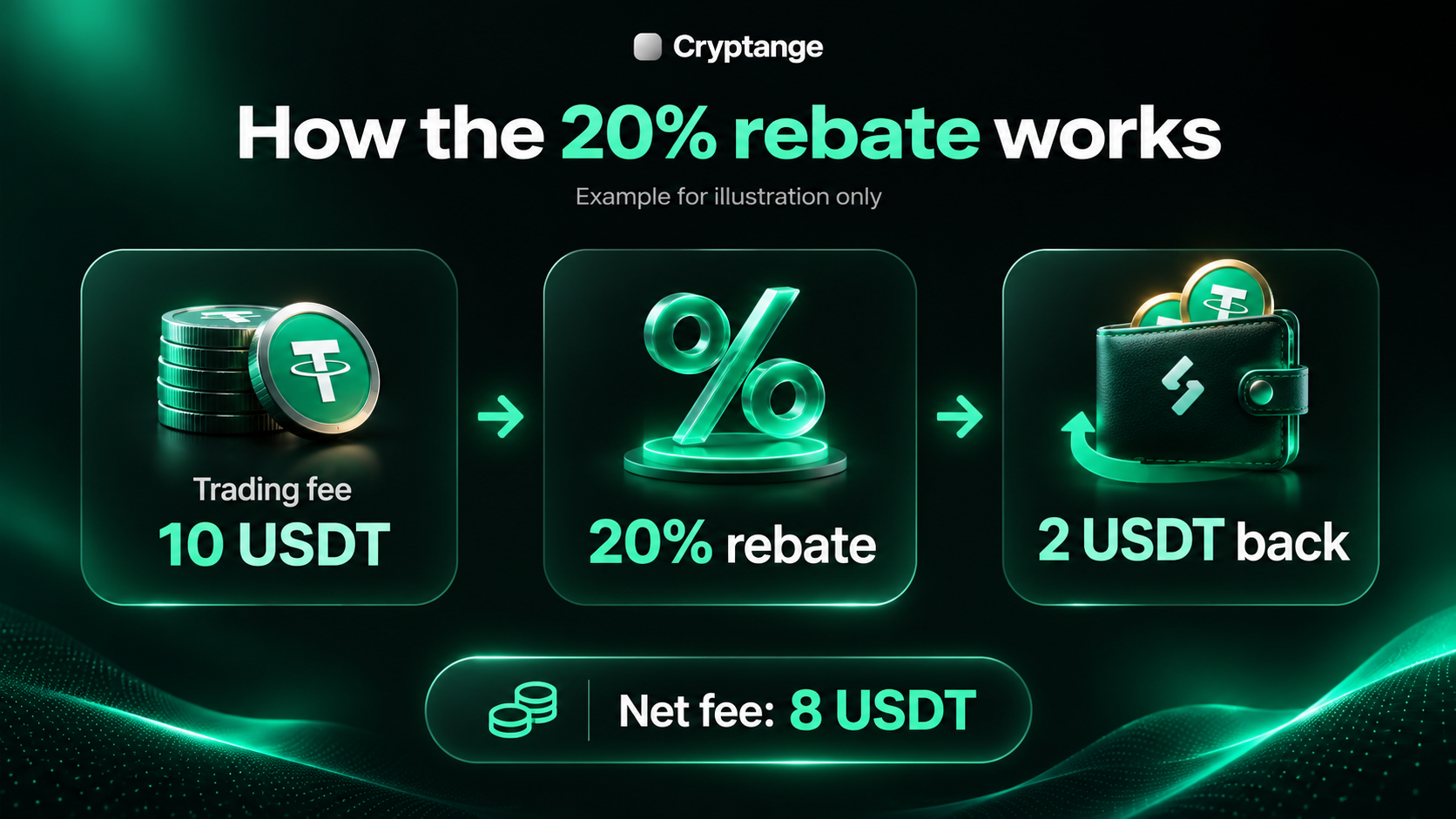
If Bitget charges you 10 USDT in eligible trading fees, a 20% share works out to 2 USDT. Your remaining trading-fee cost is 8 USDT, before other costs.
It is not 20% of your trading volume or profit. A 10,000 USDT trade does not automatically produce a 2,000 USDT rebate. The calculation starts with the fee Bitget actually charges.
Bitget's published standard futures rates are 0.02% for maker orders and 0.06% for taker orders before applicable VIP or BGB discounts.
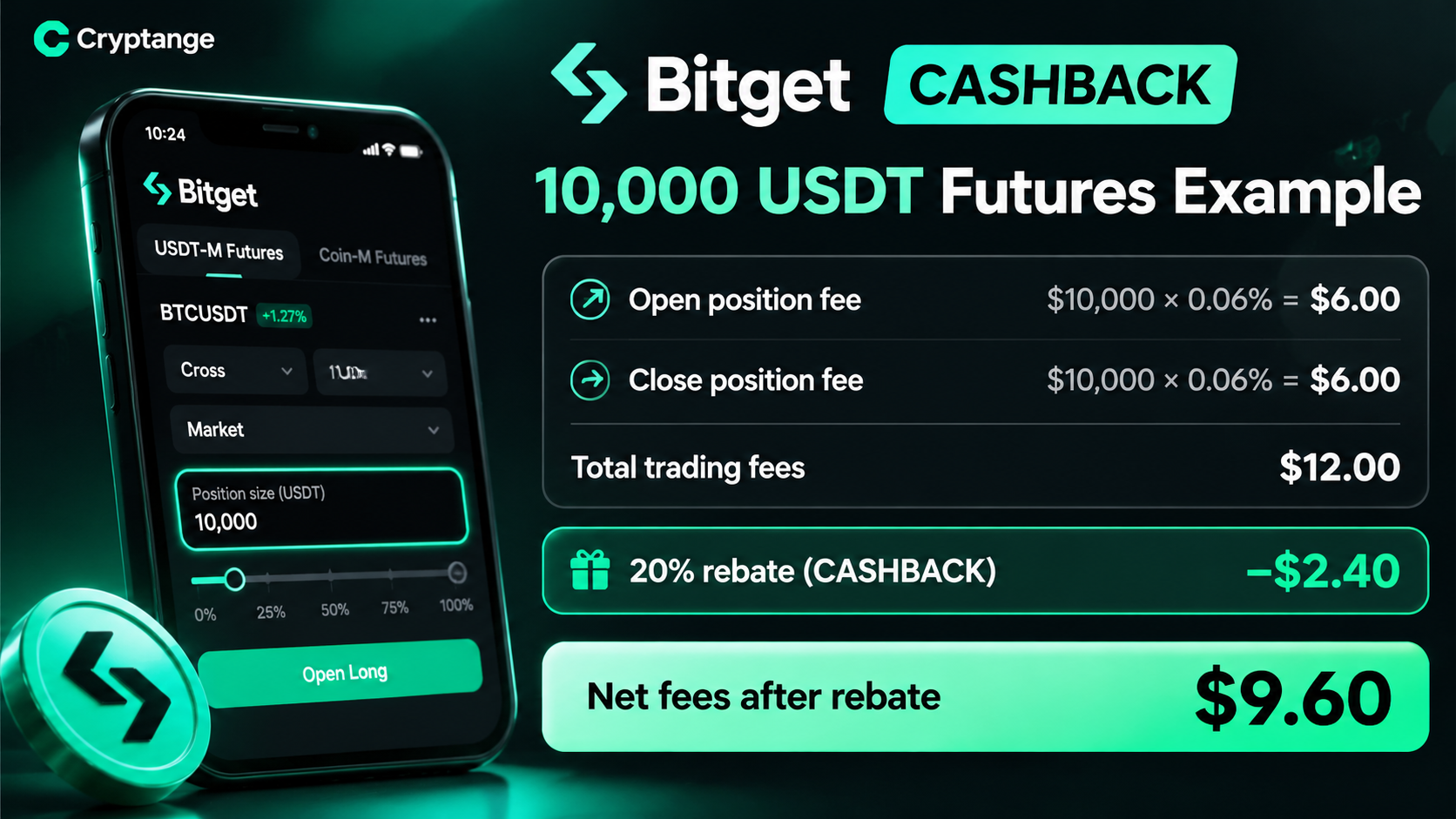
Imagine opening a 10,000 USDT futures position with a taker order, then closing a position of the same notional value with another taker order:
| Calculation | Amount |
|---|---|
| Opening fee at 0.06% | 6.00 USDT |
| Closing fee at 0.06% | 6.00 USDT |
| Total trading fees | 12.00 USDT |
| Potential 20% rebate, if both fees qualify | 2.40 USDT |
| Fees remaining after the rebate | 9.60 USDT |
This is an illustration, not a promised payout. The closing notional may differ, your account may have a different fee tier, and only fees recognised as eligible count.
For spot trading, Bitget's published standard maker/taker fee is 0.1% before discounts. A 10,000 USDT fee-bearing spot transaction at that rate would generate a 10 USDT fee. If fully eligible, the 20% calculation would be 2 USDT.
Maker orders add liquidity to the order book; taker orders fill existing liquidity. A market order is usually taker, while a limit order may be maker if it rests on the book. Check the actual execution fee in your account rather than relying on the order label alone.
Calculated at $500 fees per $1M volume; 20% back on eligible fees. Actual fees and payouts follow Bitget’s terms.
The slider below is the same monthly-volume calculator used on Cryptange's Bitget offer. Move it from smaller trading activity up to 100 million USDT to see an illustrative monthly fee estimate and the potential 20% rebate.
The current calculator uses an illustrative 0.05% average fee assumption. At that assumption, each 1 million USDT in monthly volume represents about 500 USDT in fees and a potential 100 USDT rebate at 20%, if all those fees qualify.
Your real result can be lower or higher. Bitget's fee depends on the product, maker/taker execution, VIP tier, BGB discounts and other applicable terms. The slider is a quick estimate, not a personal fee quote or a record of money paid.
The calculator estimates the fee rebate only. It does not calculate or guarantee the separate 6,200 USDT welcome package.
The CASHBACK dashboard recording displays a 20% direct-referral share for Spot, Futures, Onchain, CFD and Stock. For ordinary fee-paying trades in those displayed categories, the rebate calculation is based on the eligible trading fee actually charged.
A few distinctions matter:
Funding payments, withdrawal charges, network fees, borrowing interest and liquidation charges are different from ordinary trade-execution fees. The CASHBACK recording does not establish those charges as eligible.
The practical rule: check the fee line on the completed trade, then check the relevant rebate entry after settlement. If a bonus or voucher was active, read its terms before estimating the amount.
Bitget's ongoing campaigns page lists a Rewards Center package of up to 6,200 USDT for new users. That headline is a maximum, not a cash payment for entering CASHBACK.
Bitget's published Rewards Center explanation describes two parts:
The same explanation describes a three-day monitoring period after the promotion ends, followed by a two-day window in which eligible rewards must be claimed manually in the Rewards Center. Claimed rewards appear in the Coupons Center.
That means the headline amount depends on what you do, which tasks your account is offered, and whether you meet the conditions and claim on time. Rewards may be coupons or trading credits rather than cash that can be withdrawn immediately. Regional availability and campaign rules can also change.
Keep the two benefits separate:
Check the live Rewards Center after registration to see the tasks and reward types available to your account.
If you're opening a new account, check the code before you finish registration.
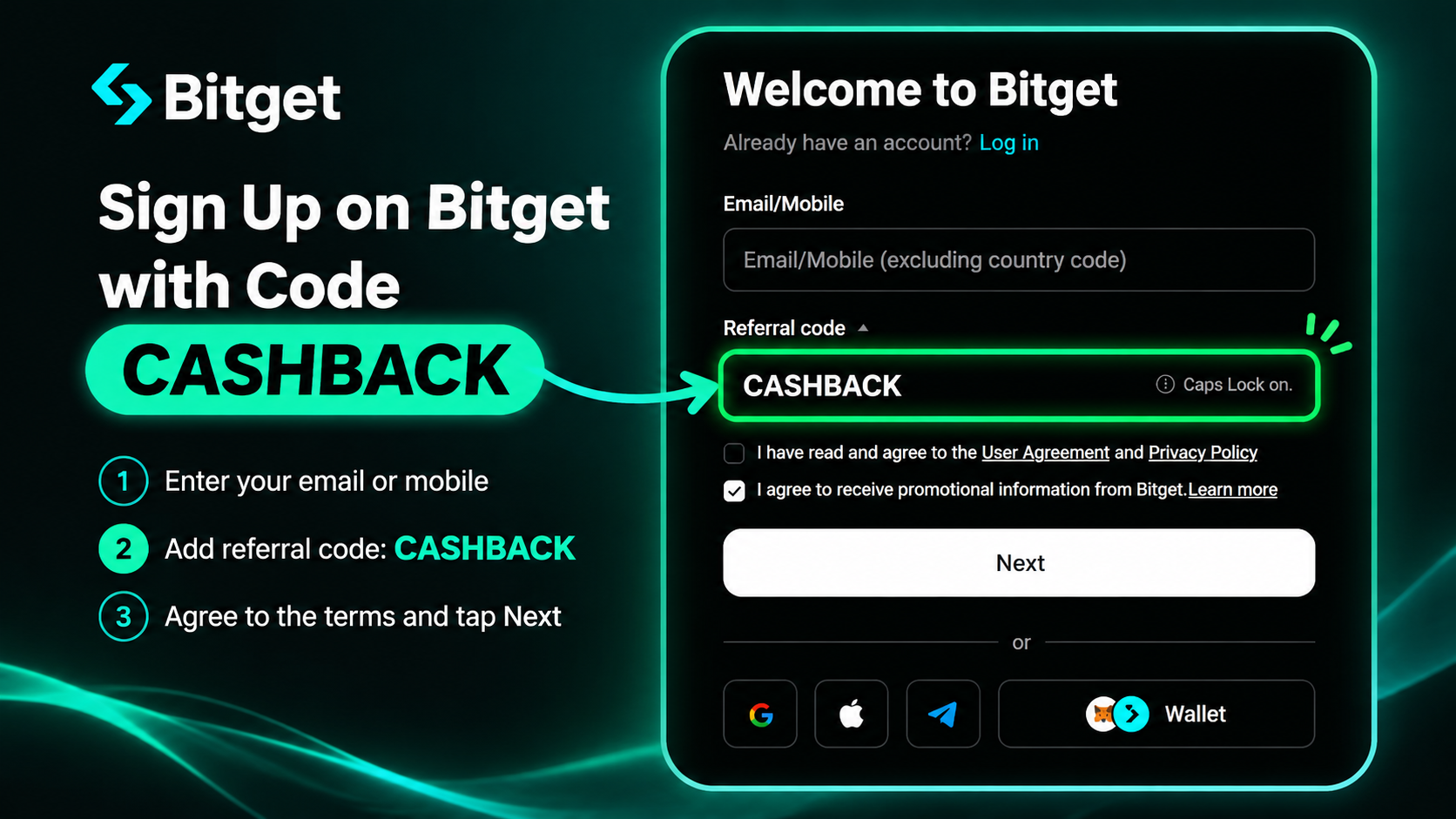
Referral attribution is normally established during registration. If you already have a Bitget account, do not assume you can add or change the code afterwards; ask Bitget Support before relying on that.
The supplied Cryptange dashboard recording shows CASHBACK configured with a 20% direct-referral share for five displayed product categories. The separate support recording explains the fee calculation and payout process. This verifies the recorded configuration, not a guaranteed payment for every future trade.
No. It is calculated against eligible trading fees. It is not 20% of your order size, deposit, balance or trading profit.
The recording shows a 20% setting for both Spot and Futures, as well as Onchain, CFD and Stock. Actual eligible fees remain subject to Bitget's current product and account terms.
The Bitget VIP Premier Support recording describes following-day distribution to the referred user's Spot Wallet. Check your own financial records to confirm the amount actually credited.
They are different benefits. The 50% figure is an affiliate-side commission tier with qualification requirements. It does not mean a new trader automatically receives 50% of their fees back.
No. It is a maximum advertised reward package tied to separate tasks and conditions. Check the current Rewards Center for the exact tasks, reward types, deadlines and regional eligibility.
Do not assume they stack. A voucher can change the fee charged or the form of the rebate. Check the terms for the specific voucher and the actual fee recorded on the trade.
No. It can reduce an eligible trading cost, but it cannot offset market losses, funding payments, spreads or liquidation risk.
The CASHBACK portal and support recordings are Cryptange's own supplied evidence. The official links above explain Bitget's published programme, fee and reward rules. Offer settings, fee schedules and campaign availability can change, so check the live terms before registering.
Cryptange may earn an affiliate commission if you register through the link. This does not affect exchange comparisons or matching results. This guide explains referral mechanics and trading costs; it is not financial advice.
Explore Bitget fees, copy-trading mechanics, security history and regional restrictions, plus CASHBACK’s 20% rebate and conditional welcome rewards.

Understand reward types, eligibility and incremental costs before letting a welcome offer influence your decision.
Kraken app versus Kraken Pro, margin and futures costs, security settings and regional access.


